
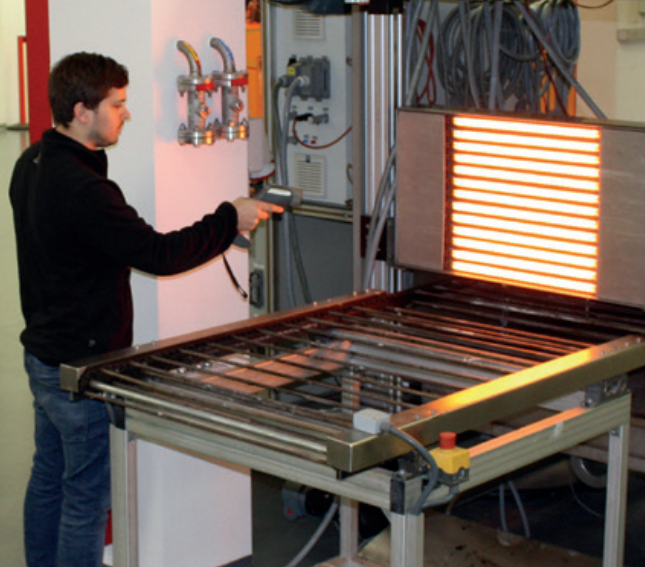
On the fab floor, a 0.5°C drift during the photoresist bake is all it takes to turn a full lot into scrap. You don’t need heat that guesses. You need heat that behaves.
What Matters Technically
Our lithography oven lamps put out short-wave infrared with tight spectral control, right where the photoresist absorbs, so you get rapid, surface-first heating. Wafer-level uniformity stays within ±0.1°C across the bake zone, and repeatability holds shot-to-shot, shift-to-shift. The lamp body and reflector geometry are built for Class 1–100 cleanroom duty, with zero particle generation verified by in-situ monitoring. Output stays stable over 5,000+ hours, with less than 5% intensity drop, so your thermal budget stays predictable.
Why It Works Here
In wafer drying, the fast, controlled pulse keeps surface tension in check and prevents re-contamination during cooldown. In soft bake, the infrared profile clears solvent without collapsing fine features, so linewidth control improves. For hard bake and curing, the same lamp architecture delivers repeatable crosslinking, giving you adhesion you can count on for the next patterning steps and for packaging. The upshot: fewer reworks, lower scrap, and cycle times that don’t wander. Energy use drops, too. The lamp heats only what needs heating, with quick on/off response and minimal idle thermal mass.
Things to Know
Matching the tool matters. Confirm the lamp envelope, base, and connector line up with your lithography oven or hotplate. After a lamp replacement, expect a short thermal soak-time to re-establish setpoint stability and uniformity maps. For best uniformity, the lamp is tuned to the specific reflector and chamber geometry — swap incompatible parts and performance falls off. After installation, run qualification strips to verify the temperature profile and particle count, then lock the process window.