
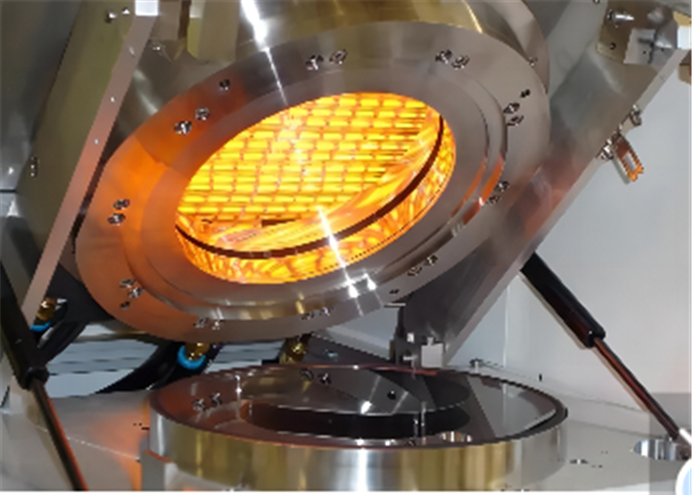
On the fab floor, solid-state battery wafer lines don’t have room for thermal drift. A soft bake that’s even a degree off starts to spread footing variation, and a hard bake that runs hot will collapse via profiles. We built our infrared solid-state battery processing heater to keep lithography and curing inside the thermal budget—lot after lot, shift after shift. What actually matters is control you can prove. Short-wave infrared dumps energy straight into thin films and substrates, fast, with wafer-level uniformity of ±0.1°C across the active zone. Temperature repeatability sits at ±0.5°C run-to-run, so the photoresist bakes that matter—soft bake, hard bake, and post-apply bake—hit spec without rework. The tool is compatible with Class 1–100 cleanrooms, and the heater design runs with zero particle generation during operation. We design for 24/7 reliability, with MTBF data that backs up long campaigns and predictable maintenance windows. Here’s why it sticks: the process window is tight, and time on the line is expensive. You get a quicker ramp to setpoint, tighter critical dimension control, and less scrap from over-cure or under-cure. Power use drops because infrared heats the target, not the frame around it. Process windows open up without chasing hot spots and cold edges, and uptime improves because the thermal profile stays stable across product mix. A practical heads-up: infrared performance hinges on the load’s emissivity and reflectivity. Coated substrates and multilayer stacks need a quick thermal qualification run to dial in the recipe. Once you map it, the system holds the profile with minimal drift—but that initial qualification is a must if you want consistent results across materials.