

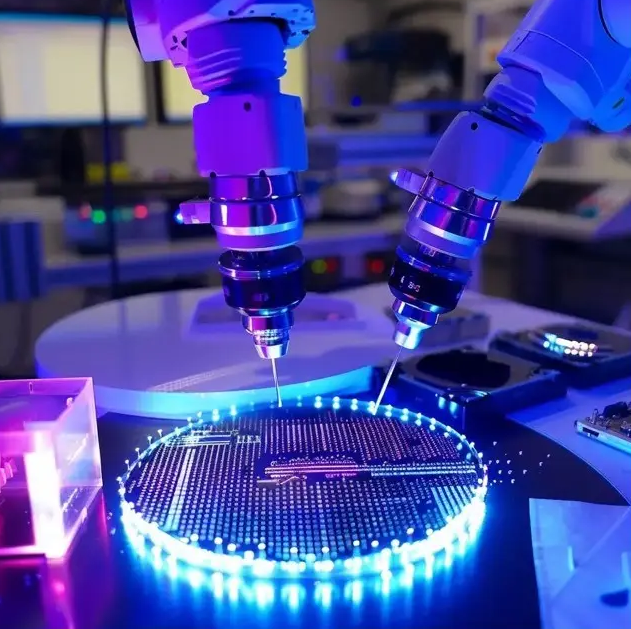
Out on the line, in a Class 1 cleanroom, a 300mm wafer settles onto the hot plate. Photoresist is set by temperature, not by wishful thinking. A 2°C drift across the surface can move CDs, toss a lithography layer, and wipe out a week’s output. We built the vacuum chamber infrared heater to take that guesswork out of the equation. What matters under the hood The heater uses short-wave quartz emitters for direct radiant heat, with response in milliseconds. Across the active area, wafer-level uniformity holds at ±0.1°C, and shot-to-shot repeatability sits at 0.05°C. The chamber body is electropolished 316L stainless steel, welded to cut down outgassing, and rated for vacuum to 10^-6 mbar. Cleanroom-compatible construction keeps particle generation at zero, even after 5,000 hours at 250°C. Integrated pyrometry and closed-loop control hold setpoint without overshoot during soft bake and hard bake. Why this works in photoresist processing The thermal budget is tight. This heater delivers precise bake profiles for soft bake and hard bake, which stabilizes critical dimensions and cuts down on rework. The fast ramp trims cycle time, and the low thermal mass keeps energy use down. You end up with consistent yield on 200mm and 300mm lines, less scrap, fewer retries, and maintenance windows you can actually plan around. What you need to account for Installation comes down to matching the chamber geometry and the emissivity of the carrier, and then tuning the heater to the specific thermal load. Expect a short commissioning run to dial in pyrometer position and ramp rates. Once it’s set, the system runs solid, but plan on quarterly emitter inspections and annual recalibration to keep that ±0.1°C uniformity that keeps the process in spec.